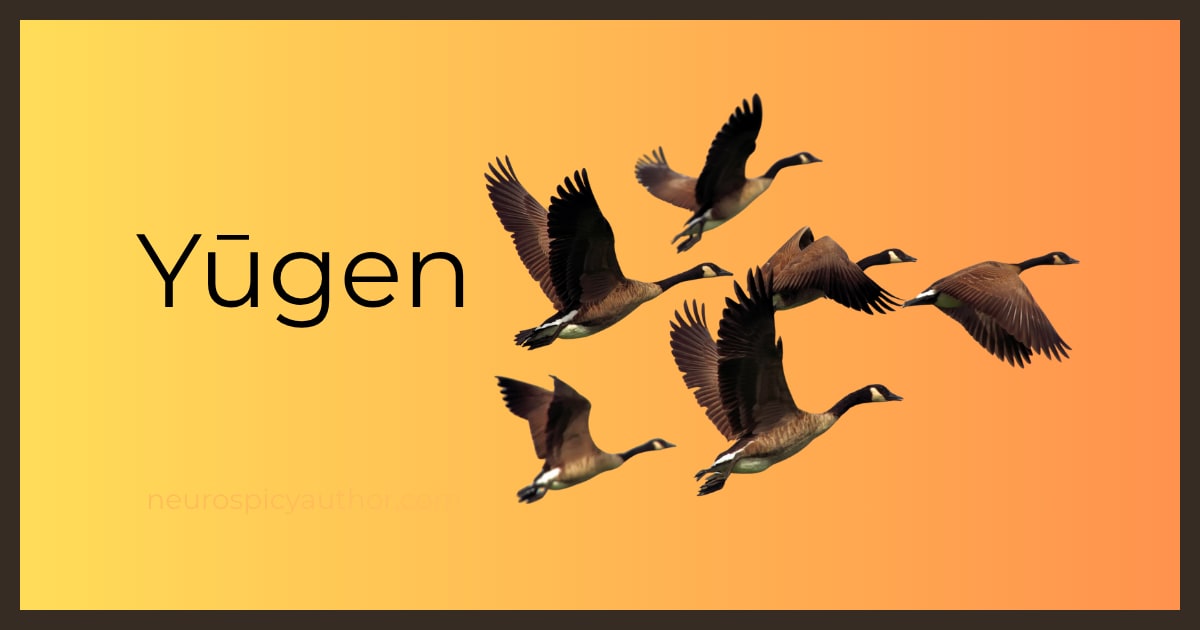
The Japanese word for the awareness of the universe that triggers a feeling too large for language. Not sadness. Not joy. Something older than either.
I was watching a flock of geese when they disappeared into the clouds.
Not dramatically. They didn't vanish all at once. They just kept going, one by one, into the grey, until the last one was gone and the sky was empty and I was still standing there looking at the place where they had been.
I didn't move for a long time. Not because I expected them to return. Because something had just happened that I didn't want to disturb.
There is a word for what I felt in that moment. It took a Japanese aesthetic concept to name it, because English never bothered.
What yūgen is
Yūgen describes a particular quality of awareness: the moment when something vast and beautiful moves beyond the boundary of what you can see, and you are left standing at the edge of it, feeling the full weight of what continues without you.
The classic images are all thresholds. Wild geese into clouds. A mountain dissolving into mist. The moon sliding behind trees before you've finished looking at it. A boat rounding a headland and gone.
These are not tragic images. The geese aren't lost. The mountain is still there. What yūgen names is what happens in you when you watch something pass beyond your perception and understand, without words, that it keeps going. That the world extends far past the edge of what you can follow.
It is not about what disappears. It is about what the disappearing reveals.
The thing about following
Here is what I understood watching those geese.
If I had followed them, the feeling would have ended. Not because I would have found them, but because the act of following replaces the mystery with a search. You cannot pursue yūgen and also feel it. The moment you move toward what disappeared, you have decided that resolution matters more than the feeling the disappearance gave you.
Yūgen asks you to stay at the edge. To accept that something is continuing beyond your sight and to let that be enough. To feel the size of what you can't follow without needing to make it smaller.
This is harder than it sounds. We are trained to resolve. To find out. To follow the geese and confirm where they went. The willingness to remain at the threshold, to let the mystery stay a mystery, is its own kind of practice.
What a neurodivergent nervous system knows about thresholds
The perceptual wiring that notices when light changes, that tracks a shadow to its edge, that registers the quality of air before a storm, is the same wiring that encounters yūgen often.
Not because it seeks transcendence. Because it is paying the kind of attention that thresholds require. The moment between light and dark. The instant a sound fades past hearing. The place where a flock of birds crosses from visible to gone.
Most people see the geese and move on. A different quality of attention stays at the place where they disappeared and feels what that absence is made of.
That staying is not distraction. It is the whole point.
If you know this feeling
You have probably stood somewhere and felt something too large to name and too quiet to explain to anyone who wasn't there.
At the edge of water as the light changed. At a window during the first real dark of evening. In a telescope eyepiece, watching a galaxy whose light left before your species existed. At the place in the sky where something was and then wasn't.
You were right to stay. You were right not to follow.
Some things are only fully themselves when you let them disappear.
-- Ptim
Ptim Pellerin is a neurodivergent author, composer, and optical scientist based in Houston. His work explores the intersection of science, art, and neurodivergent experience.