"I watch the conversations that happen between people, not just among them."
There is a man who comes to the same coffee shop every Tuesday at 3:17.
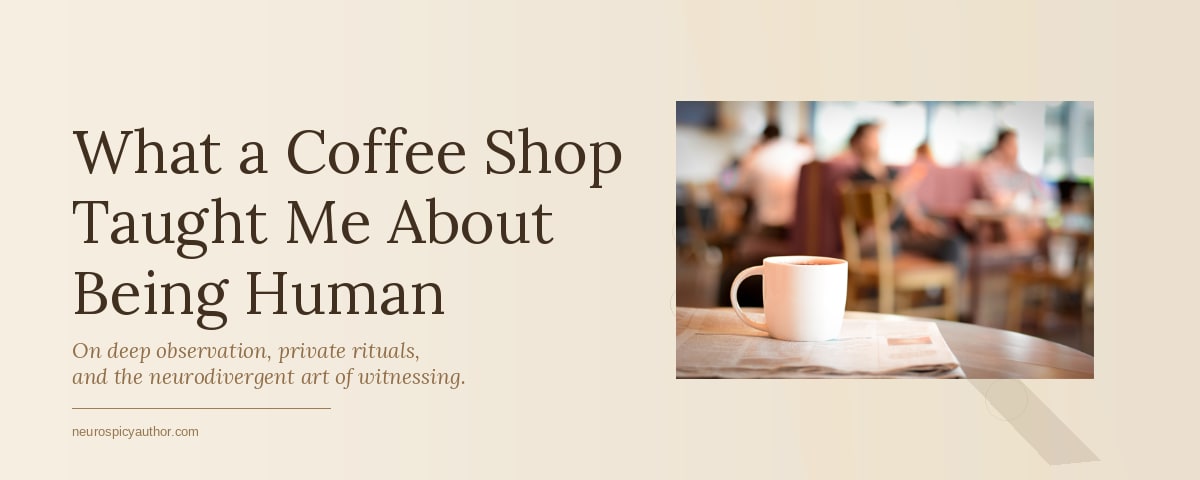
Not 3:15. Not 3:20. He arrives at 3:17, sits at the same table — second from the window, left side — and turns his coffee cup handle toward the door before he takes his first sip. He does not appear to notice that he does this. It happens the way breathing happens, the way a particular posture happens when someone sits in a chair they have sat in many times.
I have been watching him for three Tuesdays.
I understand him completely.
What Deep Observers Actually See
Most people watch what people do. I watch what people do when they think no one is watching.
There is a difference. When people know they're observed, they perform — even slightly, even unconsciously — a version of themselves calibrated for the audience. The posture adjusts. The expression modulates. The cup handle may or may not get turned toward the door, depending on whether the habit has been noticed and judged.
When people think they're unwatched, they revert to their actual choreography. The private rituals surface. The small, repeated behaviors that carry the weight of something deeper — comfort, control, grief, love, a nervous system trying to make the world slightly more predictable than it otherwise is.
This is what I watch. Not the performance. The choreography underneath.
The Neurodivergent Eye
I have been this kind of observer my whole life, and for most of it I thought something was wrong with me.
The watching felt compulsive. Involuntary. My attention would fix on something — the way a woman touched her collarbone every time she was about to say something she wasn't sure of, the way two people who claimed to barely know each other stood at an angle that said otherwise, the way a child's hands moved when the adults were arguing and the child was pretending not to notice — and I could not look away until I understood what I was seeing.
I didn't have language for it. I knew the word observation. I didn't know that what I was doing was a form of pattern recognition so deep and automatic that it registered human behavior the way a seismograph registers ground movement — continuously, at a level of sensitivity that most instruments aren't calibrated for.
This is one of the things I explored in The Voyeur of Shadows: the neurodivergent capacity to see what happens in the negative space of human interaction. Not what people say, but what they do while they're saying it. Not the stated meaning, but the shape the meaning makes in the air between people.
The Man With the Coffee Cup
I have constructed, over three Tuesdays, a partial theory of the man at 3:17.
The precision of his arrival time suggests a nervous system that finds comfort in predictability. The cup handle — turned toward the door, always — suggests something like a small private ritual of readiness: whatever comes through that door, I am oriented toward it. The table choice, second from the window, is the table with the best sightline to both the entrance and the counter. Maximum information. Minimum surprise.
He spends approximately forty minutes reading something on a tablet. He does not use headphones. He tracks sounds with a slight movement of his head — not obvious, not alarming, just present. He is aware of the room without being in it.
I recognize all of this.
I do not know his name. I do not know his history. But I know something about how his nervous system processes the world, because I have watched what it makes him do when he thinks no one is watching.
We have never spoken. We have, in some sense, been in conversation for three weeks.
What This Has to Do With Writing
The Voyeur of Shadows grew out of decades of this kind of watching.
The book is about shadow observation as a contemplative practice — the way attending to what is indirect, peripheral, and implied can reveal more than direct observation. Shadows are, literally, the record of what light encounters. They contain information about the source, the angle, the texture of the surface, the movement of what cast them. To read a shadow carefully is to reconstruct a world you cannot see directly.
Human behavior works the same way. The shadow a person casts — the trace they leave in the behavior of others, in the small unconscious choices, in the things they do at 3:17 on a Tuesday when they think they're invisible — is often more revealing than anything they would say if you asked them directly.
Neurodivergent perception, with its lateral attention and its pattern-recognition and its refusal to stop noticing things, is particularly well suited to this kind of reading.
We are, many of us, involuntary archivists of the human shadow.
The Practice of Witnessing
There is an ethical dimension to this that I think about.
To watch people this carefully is to hold something of them — something they didn't offer, something they may not know they revealed. That carries a responsibility. The knowledge goes nowhere except into understanding. It is not used against them. It is not performed back to them. It is held the way you hold anything beautiful and private that you happened to see: with care, and with gratitude, and with the awareness that you were trusted with it even though they didn't know they were trusting you.
The coffee shop man with his 3:17 arrival and his cup turned toward the door is, in some sense, my teacher. He is showing me something about how a nervous system navigates uncertainty. About what it looks like to make peace with a world that keeps being less predictable than you need it to be, one small ritual at a time.
I am grateful for the lesson.
I hope his Tuesday is always exactly what he needs it to be.
The Voyeur of Shadows — on neurodivergent perception, shadow observation, and the art of witnessing what others miss — is available at neurospicyauthor.com.