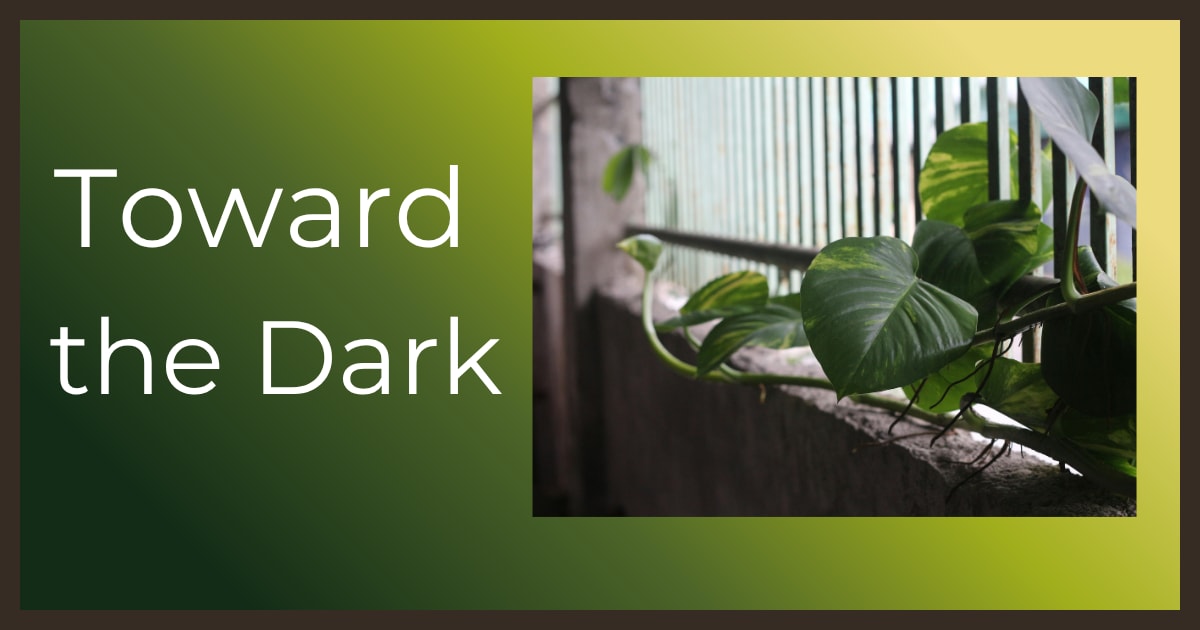
A young vine, given the choice, will grow toward the darkest corner of the room.
Not away from it. Toward it.
This seems wrong. Everything we understand about plants tells us they move toward light. Phototropism, the bending of a stem toward a light source, is one of the first things we learn about how plants work. Sunlight is energy. Sunlight is life. Of course they move toward it.
But certain vines, in their early stages, do the opposite. They detect the darkest point in their environment and grow toward it. Not because they prefer darkness. Because darkness is where the tree trunk is most likely to be. Where the shadow falls deepest is where something large and solid is standing. And that's exactly what a climbing vine needs, something to hold onto, something to ascend, something that will take it eventually into the light it can't yet reach from the ground.
The darkness is not the destination. It is the direction toward the support.
This is called skototropism. And once you know it exists, you start seeing it everywhere.
What the Shadow Tells You
A shadow is information.
We tend to read shadows as absences, the place where light isn't, the dark side of a thing, the lesser version of the lit world. But to a skototropic vine, a shadow is a signal. It points toward mass, toward structure, toward something worth climbing.
The plant doesn't know this consciously. It doesn't reason its way toward the dark. It simply responds to what the environment is telling it, and what the environment is telling it is: the support you need is over there.
There is a kind of intelligence in this that has nothing to do with cognition.
The Human Version
Some people are drawn to difficult things.
Not because they are broken or masochistic or unable to recognize what is good for them. But because they have learned, somewhere below the level of conscious decision, that the difficult thing is often where the structure is. Where the real conversation happens. Where the work that actually matters gets done.
The person who asks the uncomfortable question in the room where everyone else is comfortable. The mind that can't rest in the easy answer and keeps moving toward the unresolved edge of things. The artist who returns again and again to the theme that costs them something, because that's where the work becomes true.
These are not problems to correct. They are orientations. Responses to what the environment is communicating at a frequency most people aren't tuned to receive.
The shadow is pointing at something.
The Voyeur's Eye
To watch the world closely is to notice what most people filter out.
The way a bird lands differently depending on what it's afraid of. The way a room changes when one particular person enters it. The way a vine on a wall is moving, slowly, in a direction that seems counterintuitive until you understand what it's looking for.
The voyeur of shadows doesn't watch darkness because light is absent. They watch it because darkness carries information that light drowns out. Because the shadow reveals the shape of what cast it. Because sometimes the most important thing in the frame is the thing you can't directly see.
Skototropism is just a plant doing what certain minds have always done.
Moving toward the dark because that's where the support is.
— Ptim