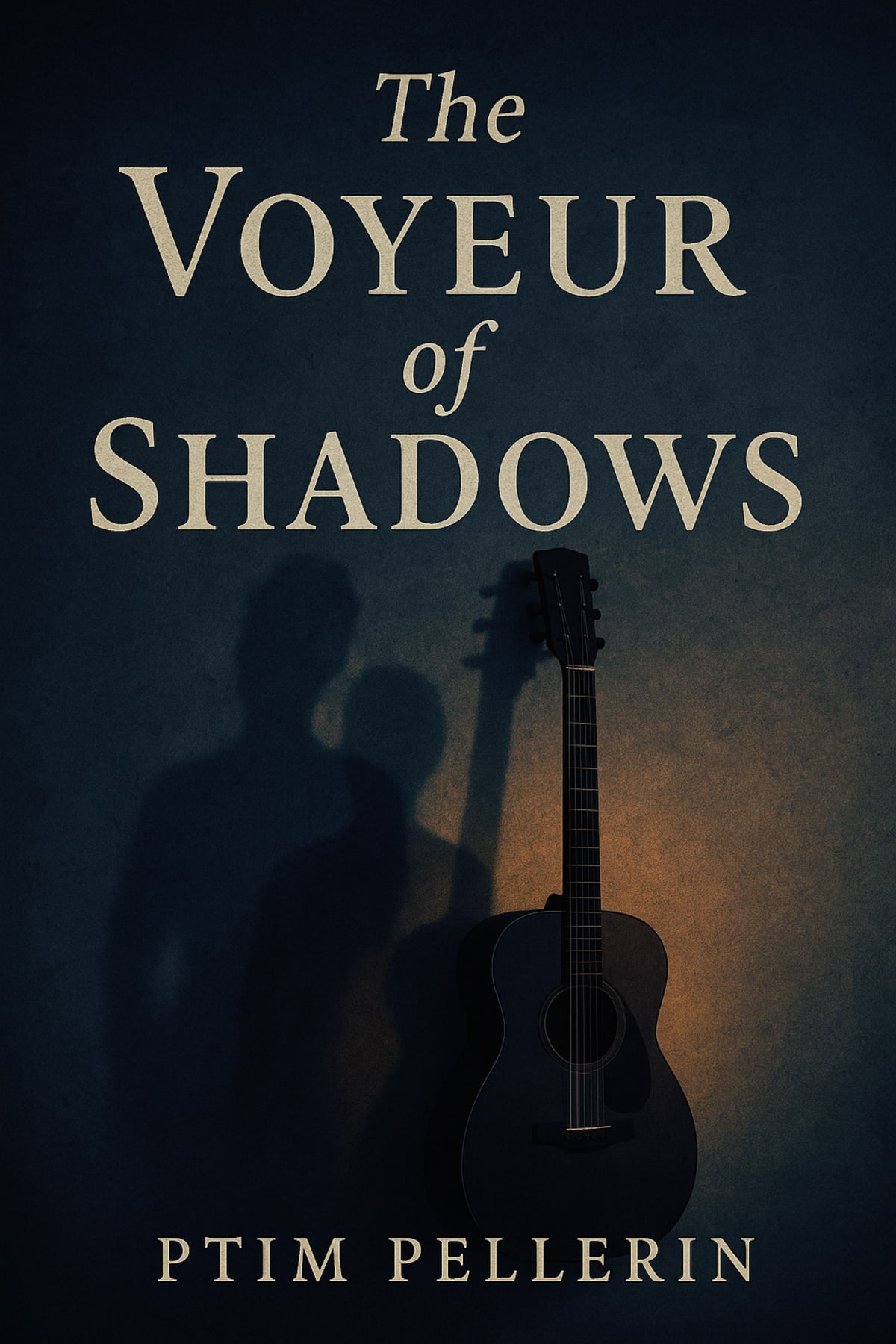
I have always noticed light and shadows.
Not as background elements. Not as decorative effects. But as conversations—constant, intricate negotiations between illumination and matter that most minds filter out as irrelevant noise.
The Voyeur of Shadows is my attempt to document what the world looks like when you can't not see these conversations. When a guitar hanging on a wall becomes three different stories told by three light sources. When shadows don't just overlap—they negotiate, creating zones of deeper darkness that feel more real than the objects themselves.
What This Book Actually Is
This isn't a book about neurodivergent perception. It's a demonstration of it.
I don't explain how autistic minds work and then illustrate with examples. Instead, I start with what I actually see—guitar shadows having a conversation—and let that direct observation reveal the deeper principles at work. The structure mirrors how pattern-recognition minds actually operate: beginning with specific sensory input, then discovering the universal grammar that connects seemingly unrelated phenomena.
By the time you reach the end, you've learned to read:
- The choreography of plants tracking sunlight at "vegetal time"
- The atmospheric autobiography written in cloud formations
- The invisible architectures people build to navigate coffee shops
- The hybrid conversations where urban systems meet natural ones
All using the same perceptual toolkit that lets me decode shadows.
The Neurodivergent Paradox
Here's the tension at the heart of the book: pattern-recognition minds are built for a world full of patterns, but pattern recognition becomes compulsive when there are too many patterns to process.
Every shadow contains physics lessons. Every cloud formation tells atmospheric stories. Every human interaction reveals complex social algorithms. The richness of perception becomes its own form of overwhelm.
This is why I developed what I call "sweeping the path"—not to eliminate complexity, but to create enough spaciousness in consciousness to witness patterns without drowning in them. To find calm within chaos not by denying the chaos but by recognizing the deeper order that emerges from apparent disorder.
From Voyeur to Participant
The book's arc moves from detached observation to something more profound: the recognition that deep seeing inevitably becomes deep participation.
When you understand how coffee shop energy flows work, you begin positioning yourself within those flows consciously. When you recognize thermal patterns that buildings create, you start moving through urban space differently. The plant on your windowsill stops being decoration and becomes a collaborator in understanding light.
The voyeur of everything discovers that "everything" includes the observer. Consciousness itself is a pattern-forming system in constant conversation with all the other pattern-forming systems it encounters.
Why Shadows?
Shadows are literally the absence of light, but they reveal form. They're created by illumination but exist as darkness. They're the negative space that defines the positive.
It's a perfect metaphor for neurodivergent perception—seeing what's not there as clearly as what is. Finding meaning in the gaps and edges that others overlook. Reading the grammar of absence and presence that tells the story of how consciousness encounters the world.
But they're also not a metaphor. They're the real thing I've been reading my whole life.
Who This Book Is For
The Voyeur of Shadows is for:
Neurodivergent readers who've been told their "obsessive attention to irrelevant details" is a deficit, not a sophisticated form of intelligence. This book reframes what you've always seen as a way of reading the universe's deeper architecture.
Neurotypical readers curious about what the world looks like through a different perceptual lens. You won't just learn about how neurodivergent minds work—you'll temporarily see through one.
Anyone who's ever gotten lost watching light move across a wall and wondered if there was meaning in that fascination. There is. Let me show you.
The Deeper Grammar
What starts as observation of guitar shadows expands into something much larger: the recognition that the same principles governing shadow formation also govern weather systems, urban ecosystems, plant growth, human social dynamics, and consciousness itself.
Negotiation. Adaptation. Pattern formation. The constant search for stability within change.
The neurodivergent mind, with its inability to filter out "irrelevant" information, becomes a sensitive instrument for detecting these structural similarities across seemingly unrelated phenomena. We become translators of a universal grammar that most minds cannot see.
An Invitation
This book is an invitation to develop what I call "pattern patience"—the ability to let systems reveal their secrets at their own pace rather than demanding immediate understanding.
The pothos plant's daily light-tracking becomes a teacher in biological time.
Cloud formations become instructors in atmospheric patience.
The barista's energy rhythms become lessons in human temporal patterns.
And through this cultivation of deep seeing, the overwhelming quality of pattern recognition transforms into something more like fluency. You learn to tune your attention like adjusting radio frequencies, picking up the conversation you want to follow while letting others recede into background texture.
Read It
The Voyeur of Shadows is available now.
Come learn to read the conversations happening in the spaces between light and matter. Discover that what appears to be empty space is actually full of meaning. Find out what the world reveals when you learn to see in the dark.
We who watch everything discover that everything is watching us back—that the universe is an infinite hall of mirrors where consciousness encounters itself through shadow and light, pattern and chaos, observation and participation.
The guitar hangs motionless on the wall.
But its shadows are having a conversation.
Always have been.
You just need to learn how to listen.
Ptim is a neurodivergent author, experimental musician, and founder of Ashes to Artworks. As "Phantom of the Artpera," Ptim creates therapeutic experimental music, and through NeuroSpicy Author, explores neurodivergent intelligence through contemplative, pattern-rich prose. Learn more at neurospicyauthor.com