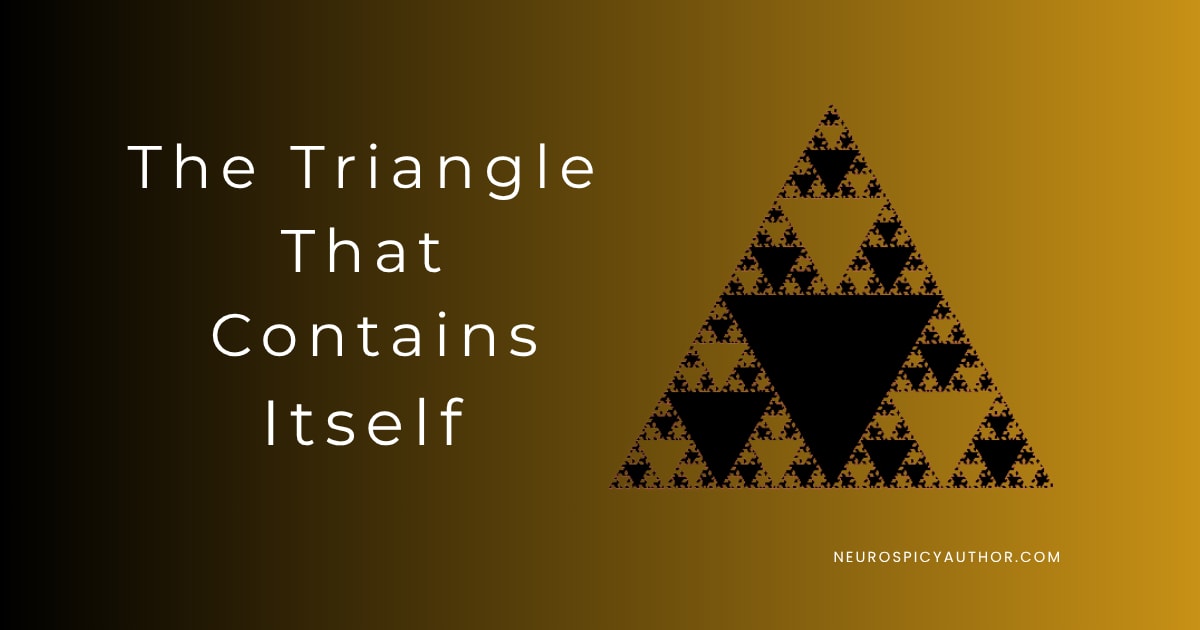
There is a triangle that, when you divide it, becomes three smaller versions of itself.
Divide those, and you get nine. Divide those, and the pattern continues — infinitely, in theory, each scale revealing the same structure as the one above it. The Sierpiński triangle doesn't just repeat. It contains itself. All the way down.
Mathematicians call this self-similarity. The pattern at the large scale is the same pattern at the small scale. Zoom in or zoom out — the triangle is still there.
I think about this often. Not because I spend much time with formal mathematics, but because this is how certain minds experience the world.
The Pattern Before the Name
Some people encounter an idea and file it away. Others encounter an idea and immediately begin seeing it everywhere.
The second kind of mind isn't being dramatic. It isn't projecting. It is doing something specific and real — recognizing that the same underlying structure keeps appearing in different materials. The way a river delta looks like a lung looks like a tree looks like a bolt of lightning. The way the rhythm of a heartbeat and the rhythm of a drum and the rhythm of breathing are all, at some level, the same conversation happening in different rooms.
This is pattern recognition. Not as a skill to be practiced but as a way of perceiving — one that some minds do naturally, often before they have language for what they're seeing.
Neurodivergent minds tend to do this with unusual intensity. The connection arrives fast, before the analytical mind has caught up. Sometimes it feels like intuition. Sometimes it feels like being distracted. Often it is neither — it is simply a nervous system that is very good at finding the triangle inside the triangle.
What the Pattern Points To
The Sierpiński triangle has a strange property.
As you keep dividing it, something happens to the space inside. The triangles get smaller and more numerous, but the total area they occupy approaches zero. The pattern becomes infinitely detailed while simultaneously becoming almost nothing. Structure everywhere. Substance nowhere.
This is what happens at the edge of a deep pattern. The closer you look, the more detail you find — and the more the detail points past itself toward something that can't quite be captured. The pattern is not the thing. It is the thing pointing at the thing.
I've found this to be true in music. The rhythm and the drone and the silence and the breath are not the spell. They are the structure that the spell moves through. The closer you listen, the more you hear — and the more what you hear points past hearing toward something else entirely.
Why This Matters
Most of us are taught to find the answer and stop looking.
Pattern recognition suggests a different relationship with knowledge — one where the point is not to arrive but to keep noticing the structure. To stay curious about why the same shape keeps appearing. To follow the triangle down into itself not because there is a final triangle waiting at the bottom but because the following itself is the practice.
This is not a comfortable way to move through the world. It is also not a broken one.
It is simply a mind that cannot stop seeing the pattern inside the pattern.
Which, if you think about it, is just another triangle.
— Ptim