On reproduction, continuity, and the thread that runs through everything alive.
It was around six in the evening, the day after a rainstorm.
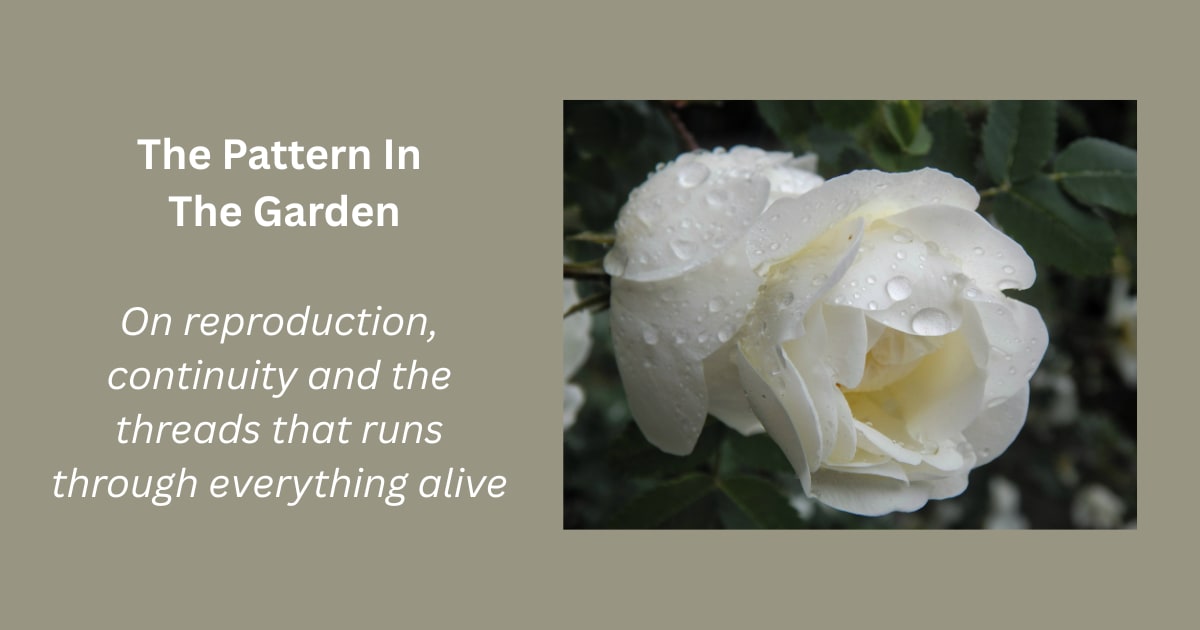
The sky was still partly cloudy, the air moving, that particular quality of light that comes when the sun finds gaps in the clouds after a long rain — everything wet and a little luminous. The white roses in my garden were holding water in their petals. And somewhere near a puddle at the edge of the yard, a Gulf Coast toad was trilling.
I wasn't trying to think about anything in particular. I was just outside, coming down from a long day, letting the garden do what gardens do.
And then the thread appeared.
What the Toad Was Doing
The toad was calling for a mate. That's what the trill is — an advertisement, a signal, an urgency broadcast into the wet air above a puddle. Something in him needed to do it. Not decided to. Needed to.
I looked at the roses. The whole architecture of a rose — the color, the scent, the particular arrangement of petals — exists to attract pollinators. The flower is not calling the way the toad is calling. But it is reaching, in its own way. Creating conditions. Making itself irresistible to whatever will carry its pollen forward.
Two completely different organisms. Two completely different strategies. The same instruction underneath both of them.
Continue.
How Far Down It Goes
I started following the thread.
Every organism in the animal kingdom carries some version of this — but the character of it changes as you move down the complexity scale. The toad feels it as urgency, something close to longing. Mammals feel it even more acutely — the drive bound up with emotion, attachment, the whole architecture of pair bonding and offspring protection. The higher the nervous system, the more elaborate the expression of the same underlying instruction.
Go further down and it simplifies. A flower enacts it without feeling it, or at least without anything we'd recognize as feeling. A single-celled organism divides — no urge, no drive, just the execution of a process so fundamental it barely qualifies as behavior. It simply happens, the way a crystal grows or water flows downhill.
And then there are viruses. Not even technically alive by the strictest definition. No metabolism, no cells, no internal experience of any kind. Just a strand of genetic information wrapped in protein — an instruction with no instructor. And yet that instruction compels every system it enters to copy it, to propagate it, to send it forward.
The drive toward continuity doesn't require consciousness.
It predates consciousness by billions of years.
The Same Pattern, Every Scale
This is what neurodivergent pattern recognition actually does, when you let it run.
It doesn't stay in one domain. It follows the thread wherever it leads, across scales, across categories, across the boundaries that usually keep ideas separate. And what it finds, again and again, is that the boundaries are somewhat arbitrary. That the same structure keeps appearing in different materials, different contexts, different scales of existence.
The toad and the rose and the bacterium and the virus are not four separate things expressing four separate drives. They are four expressions of the same thing — continuity, the imperative to persist and propagate — wearing whatever form the available complexity allows.
The pattern is the same. The organism is just the current vessel carrying it forward.
What the Garden Was Saying
I didn't go outside to think about any of this
I went outside because it was evening after a rainstorm and the air smelled like wet earth and the roses were white and the toad was trilling over his puddle. I went outside to be outside.
But this is how my brain works. It doesn't compartmentalize. It notices, and then it follows, and then it arrives somewhere it wasn't expecting — somewhere that turns out to connect to everything else it's been thinking about for years.
A toad calling for a mate on a cloudy evening in Houston is the same pattern as a galaxy forming from a cloud of gas and dust. The same imperative — to organize, to persist, to send something of yourself forward into time — expressed at completely different scales, in completely different materials, by completely different kinds of being.
Patterns of Infinity is a book about exactly this. About the thread that runs from the microverse to the universe and back again. About the recognition that what looks like diversity on the surface is often the same structure, repeated.
I find it everywhere I look.
The garden was just reminding me.
— Ptim
Ptim Pellerin is a Houston-based neurodivergent author. Patterns of Infinity is available now at neurospicyauthor.com.