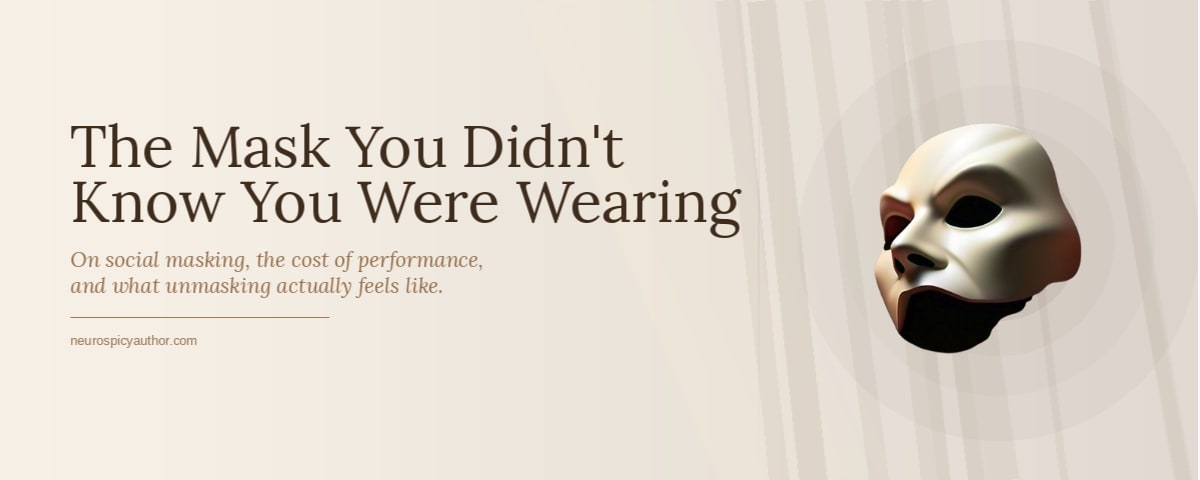
"The mask isn't something you put on. It's something you discover you've been wearing your whole life."
I was thirty-eight years old before I understood that the way I moved through the world was a performance.
Not a conscious one. Not a deliberate choice to present a false version of myself. Something that had begun so early, in response to such consistent feedback, that it had become completely invisible — to everyone around me and, most thoroughly, to myself.
The unmasking didn't happen in a therapist's office or at a diagnosis appointment. It happened in a grocery store, when I caught myself automatically modulating my voice, my eye contact, my posture, my vocabulary, the pace of my speech — all simultaneously, all without thinking — and realized I had no idea what I was like when I wasn't doing that.
It was the most disorienting moment of my adult life.
What Masking Actually Is
Social masking in neurodivergent contexts refers to the process of suppressing, camouflaging, or compensating for neurodivergent traits in order to appear more neurotypical. It shows up in autistic people, in ADHD people, in anyone whose natural way of being has been consistently received as wrong.
The clinical literature on masking tends to treat it as a strategy — something people do deliberately to navigate social environments. And that's partially true. But it misses the most important thing about how masking actually works for most people who do it.
You don't decide to mask. You learn to mask, so early and so thoroughly that the learning disappears and what's left looks like just how you are.
The child who is told repeatedly — through words, through looks, through the way people pull away — that their natural responses are too much, too weird, too loud, too intense, too still, too different — that child doesn't decide to perform neurotypicality. They adapt. They survive. And over years and decades, the adaptation becomes the only version of themselves they know.
The Weight of It
Masking is metabolically expensive in a way that is genuinely difficult to communicate to people who don't do it.
It requires continuous, real-time monitoring and adjustment of behavior that neurotypical people perform automatically. Making eye contact that looks natural but isn't. Producing facial expressions that match the social context but don't match the internal state. Modulating the voice to sound interested, or calm, or engaged, at volumes and registers that feel foreign. Suppressing the physical responses — the stims, the postural shifts, the sounds — that would otherwise happen naturally.
All of this runs in parallel with whatever else you're supposed to be doing: listening to the conversation, processing the environment, making decisions, responding appropriately.
The result is what many neurodivergent people describe as autistic burnout or ADHD exhaustion — a profound depletion that doesn't make sense to people on the outside because nothing that dramatic appears to have happened. You just went to a party. You just had a meeting. You just made it through a normal day.
But you ran two operating systems simultaneously for eight hours, and one of them was a full-body simulation of being a different kind of person.
The Discovery
For a lot of neurodivergent people, the moment of realizing they've been masking is destabilizing in a specific way: it raises a question that doesn't have an easy answer.
Who am I when I'm not doing this?
The mask has been in place long enough that it's hard to remember what was underneath it. The preferences that were suppressed. The responses that were trained away. The version of yourself that existed before the feedback started shaping you into something more acceptable.
Some of this can be recovered. In neurodivergent-affirming spaces — communities, relationships, therapists, the slowly expanding cultural conversation about what neurodivergent experience actually is — people find their way back to things they didn't know they'd lost. The stim they used to do. The way they used to talk about the things they love. The pace they actually want to move through the world at.
Some of it turns out to be not recovery but discovery — traits and preferences and ways of being that were never allowed to develop in the first place, emerging for the first time in conditions where they're finally safe.
Autistic Pride Day
June 18 is Autistic Pride Day — a day that emerged from the autistic community itself as an assertion that autistic identity is not a medical problem to be treated but a form of human neurology to be respected.
The pride framing matters precisely because of masking. When your natural way of being has been treated as something to hide, to correct, to perform your way out of — claiming pride in that identity is not a small gesture. It's a direct counter to the message that shaped the mask in the first place.
You were not wrong. The feedback was wrong.
You were not too much. The environments that couldn't hold you were too small.
The mask was a survival strategy, and it served you, and it cost you. You don't have to hate it. But you also don't have to keep wearing it in every room, for every person, for the rest of your life.
There are rooms where you can take it off. There are people who want to meet the person underneath. There is a version of you that has been waiting, with remarkable patience, for conditions safe enough to exist in.
Unmasking Is Not a Single Event
I want to be careful not to make unmasking sound like a destination — a moment of revelation after which you are simply, finally, authentically yourself.
It isn't like that.
Unmasking is a practice, not an event. It happens in increments, in specific contexts, with specific people, as trust is built and safety is established. Some contexts require masking — or a version of it — and choosing strategically when and where to unmask is not inauthenticity. It's navigation.
What changes is the awareness. Once you know the mask is there, you can make choices about it rather than simply living inside it without knowing. You can notice the cost of wearing it in a particular situation and decide whether that cost is worth paying. You can find the places where it isn't necessary and let yourself be less managed, less performed, less translated.
And over time — not all at once, not in every room, but incrementally and irreversibly — the version of yourself underneath the mask gets more air.
That matters. It matters enormously.
Voyeur of Shadows — on perception, the hidden life of things, and what neurodivergent minds see when they look closely — is available at neurospicyauthor.com. Stim Cells — on stimming, sensory experience, and the intelligence of ND behavior — is also available there.