On depth, direction, and the journey that was never going anywhere.
We are trained, from the beginning, to measure progress by distance.
How far have you come. How much ground have you covered. How close are you to the finish. The whole architecture of achievement — in school, in work, in spiritual practice, in therapy, in self-development — is built on the assumption that you start somewhere inadequate and move toward somewhere better. That the point is to arrive.
I spent a long time believing this about everything. Including myself.
The evidence seemed clear enough. There was always more ground to cover, always a further point on the horizon, always a version of arrival that kept receding as I approached it. I was good at forward motion. I could generate momentum the way some people generate anxiety — automatically, continuously, without needing a reason.
What I wasn't good at was stopping.
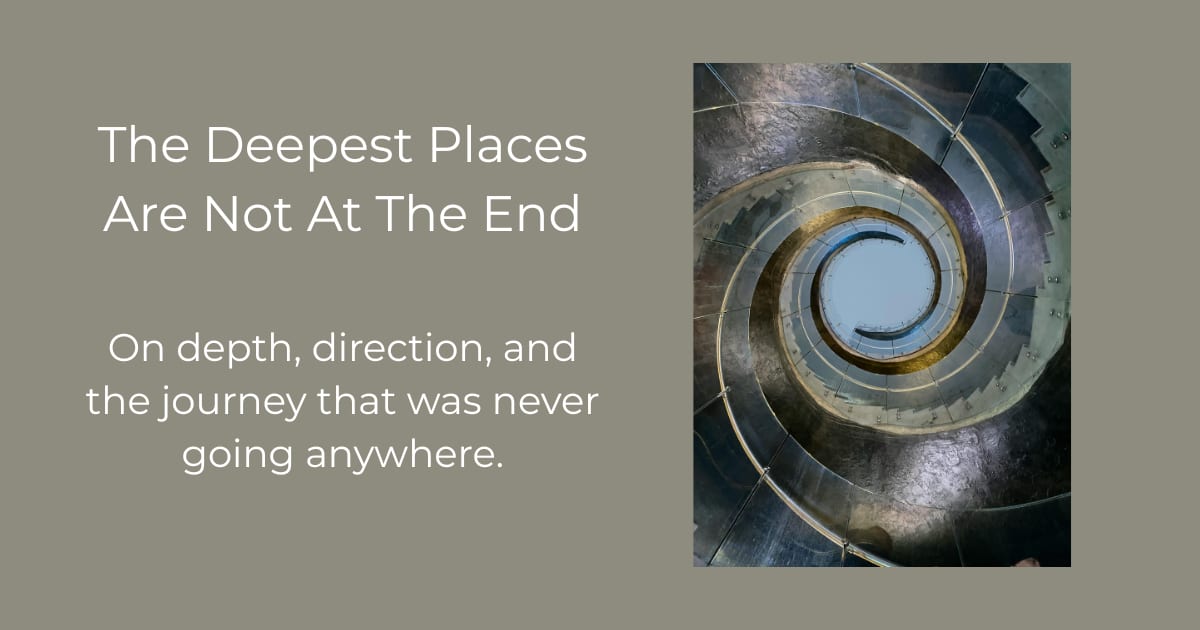
What I discovered, slowly, is that there are two kinds of going deeper. One is the kind we're taught — forward motion, accumulation, the next level of whatever you're pursuing. The other is vertical. Underneath. Into the thing you're already standing on rather than away from it toward something else.
You've probably felt the second kind without having a name for it. A walk you've taken so many times it stopped registering — and then one morning, for no particular reason, it did. Not because anything was different. Because you stopped moving through it and started being inside it. The same trees. The same light. A depth that was always there, invisible until you stopped rushing past it.
Or a conversation that had been happening on the surface for years, and then something shifted and you were suddenly in it differently. Further in. Not because new ground was covered but because you finally stopped trying to cover ground.
Or a piece of music you'd heard a hundred times that one day stopped being background and started being something you were actually inside. Nothing in the music changed. Something in the listening did.
This is the direction nobody teaches. Not forward. Down.
It runs counter to almost everything our culture values about progress and productivity and the virtue of forward motion. But it is consistent with something older — the understanding, present in every contemplative tradition I've encountered, that the richest places are not at the end of a journey. They are underneath the one you're already on.
The path doesn't lead somewhere else. It leads down.
And down is where everything worth finding actually lives. Not at the destination you've been working toward, but in the depth available in this moment, this walk, this conversation, this ordinary Tuesday that didn't announce itself as significant and turned out to be exactly where you needed to be.
Listen to the Spell is, among other things, an exploration of what sound can do when you stop asking where it's going. When you let it take you down instead of forward. When you discover that the music you've been listening to has been trying to show you something that was underneath the whole time — not at the end of the piece, but inside the middle of it, available the moment you stopped waiting for it to arrive somewhere.
The deepest places are not at the end of a journey.
They are underneath the one you're already on.
You don't have to go anywhere.
You just have to stop leaving where you are.