On sound, sensation, and the presence that lives below thought.
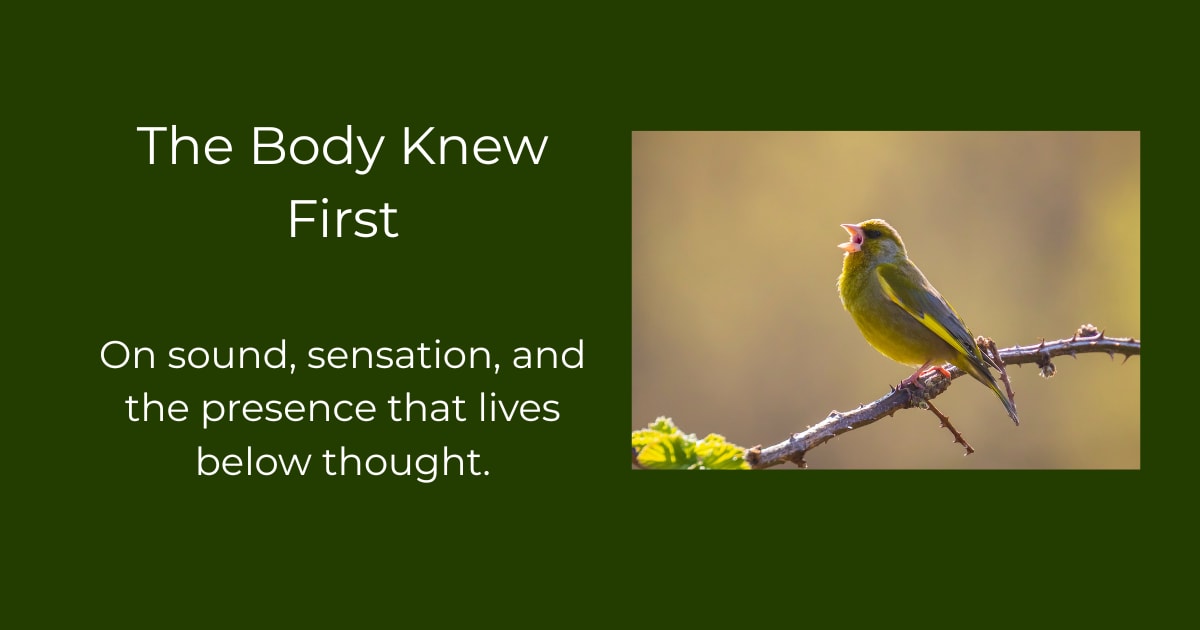
You hear birdsong and something in you relaxes.
Not because you decided to. Not because you thought: birds are singing, therefore I am safe, therefore I will now release the tension I've been carrying in my shoulders since Tuesday. The relaxation happens before any of that. Before the thought. Before the decision. Before you've even consciously registered that what you're hearing is birds.
Your nervous system got there first.
And here is why: if birds are singing, no predator is nearby. This is information your body has been reading for longer than the human species has existed. Longer than language. Longer than any cultural framework you were raised inside. The birds sing, the threat assessment updates, the body softens. It happens in milliseconds. It happens without your permission or participation.
You didn't learn this. You inherited it.
But something else happens in that moment too — something quieter than the relaxation and just as real. When the birdsong lands and the body softens, the forward motion of the mind slows down. The list of things you were mentally rehearsing, the conversation you were replaying, the problem you were pre-solving — all of it loses its grip, just briefly, on your full attention. And what's left is this. Right here. The specific quality of this particular morning, this particular light, this particular sound arriving in this particular body.
Presence doesn't announce itself. It just appears in the space that opens when something pulls you out of your head and back into your senses.
Sound does this more reliably than almost anything else. Not because it's magical — because it's biological. The nervous system receives acoustic information faster than conscious thought can form. By the time you know you're hearing something, your body has already decided what to do about it. And when what it decides is safe — when the signal is birdsong, or a resonant tone, or a rhythm steady enough to trust — it doesn't just relax. It arrives. It lands in the present moment the way it can't when it's braced against what might be coming next.
This is what I mean when I say the body knows first. Not as a metaphor. As the literal sequence of events between a sound arriving and a thought forming about it.
Most of us were never taught this. We were taught to trust the mind's interpretation over the body's knowing. To treat sensation as data to be analyzed rather than intelligence to be received. To explain and justify and translate our experience into language before it counted as real.
But the body was never waiting for the mind to catch up.
I've worked with sound as a therapeutic tool long enough to know that the most profound responses rarely come from music people expect to be moved by. They come from the unexpected arrival. The tone that finds the nervous system before the mind can screen it. The rhythm the body synchronizes with before any conscious decision to participate has been made.
For those of us who have spent years running on overdrive — braced, vigilant, treating ordinary environments as problems to be solved — the experience of a sound the body simply trusts is not a small thing. It is sometimes the first evidence in a long time that settling is possible. That underneath all the noise and the vigilance and the accumulated weight of moving through a world that wasn't designed for your particular nervous system, the body still knows how to do this.
And in that settling, something else becomes available. Not a technique. Not a practice you have to maintain through effort and discipline. Just the present moment, which was always there, waiting underneath the motion.
Presence. Birdsong found it for you.
Below thought. Below language. Below everything that accumulated on top of the thing that was always there.
The birds are still singing.
Your nervous system already knows what that means.
And if you're still enough to notice — so do you.
— Ptim
Ptim Pellerin is a Houston-based neurodivergent author, musician, and founder of Calm in Chaos Music Therapy. Listen to the Spell: Music as Magic is available now on Amazon and at neurospicyauthor.com.