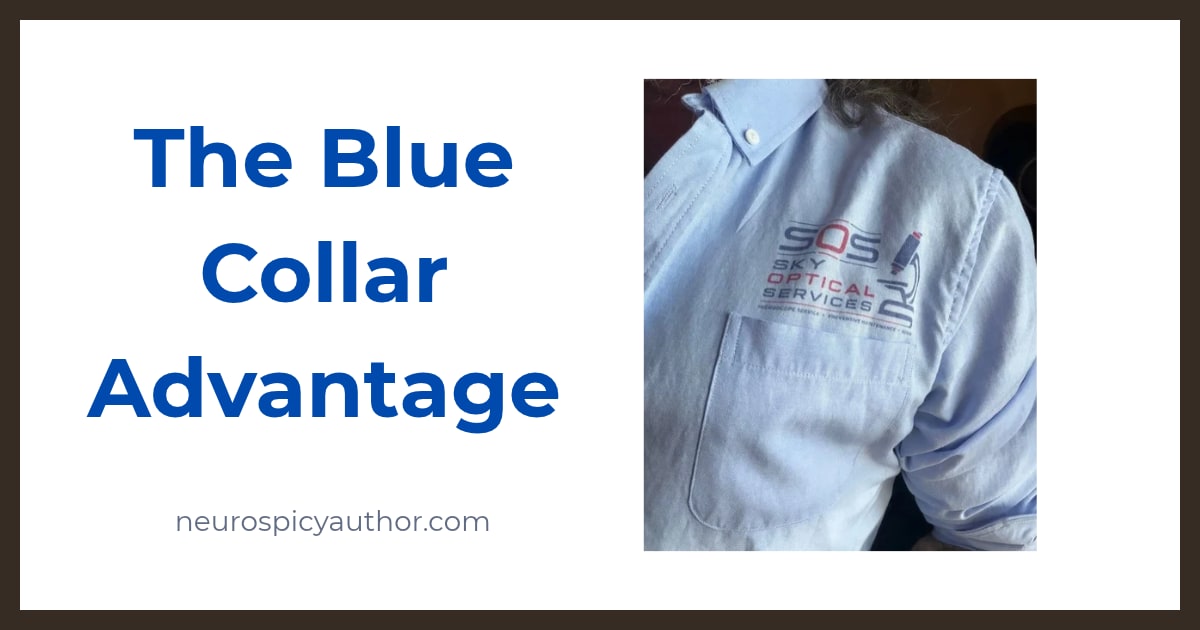
I wore a blue shirt to work yesterday.
Not metaphorically. An actual blue oxford with my company logo on the chest, because I was going to be inside a hospital lab with my hands in a microscope, and that is what that work looks like. There is no version of it that happens remotely. There is no prompt you can write that cleans a contaminated objective lens. There is no AI that can tell you, from the feel of the focusing mechanism, that the grease has dried out and the stage bearings need attention before the next service call becomes a repair call.
This is, by every traditional measure, a blue collar job. And right now, in the middle of an economy that is quietly restructuring itself around what machines can and cannot do, I think that is one of the best things a job can be.
What AI is actually replacing
The jobs disappearing fastest right now are not the ones people expected.
For decades the assumption was that automation would come for physical labor first. The assembly line worker, the warehouse picker, the truck driver. And some of that is happening. But the disruption hitting hardest right now is landing in white collar territory: paralegals, junior analysts, content writers, customer service teams, entry-level coders, radiologists reading routine scans. The work that happens on a screen, with information, at a distance from the physical world.
It turns out that distance from the physical world is exactly the vulnerability. If your work can be described in words and produced in words and delivered in words, a language model can approximate it. Not always well. Not without oversight. But well enough to compress the market for it dramatically.
The microscope on the bench in the hospital lab does not have this problem. It needs someone who can see it, touch it, diagnose it, and fix it. That someone needs forty years of accumulated knowledge about how these instruments behave, what they sound like when something is wrong, what the image tells you about the optics before you even open the housing. That knowledge does not exist in a training dataset in any form that makes it actionable without a human body in the room.
The dignity that got misplaced
At some point in the last few decades, blue collar became a consolation prize.
The message, delivered in a thousand subtle ways through guidance counselors and college rankings and career advice columns, was that working with your hands was what you did if you couldn't do something better. The better things all happened at desks, preferably in climate-controlled buildings with badge access and a benefits package that included dental.
The trades disagreed, quietly, by continuing to be essential.
The plumber still comes when the pipe bursts. The electrician still wires the building before anyone moves in. The biomedical technician still keeps the equipment running that the hospital depends on to function. None of these people were replaced by software. None of them are going to be. And all of them, in the current economy, have something that a lot of recently disrupted white collar workers are discovering they don't: a skill that requires a human being to execute it.
That is not a consolation. That is an advantage.
What neurodivergent people know about this
There is a particular kind of intelligence that has always been undervalued by systems that measure intelligence through standardized tests and academic credentials.
The intelligence that knows, from touch and sound and accumulated pattern recognition, what is wrong with a mechanical system. The intelligence that hyperfocuses on how things work until it understands them completely. The intelligence that finds the diagnostic puzzle genuinely interesting, that notices the thing everyone else missed, that can hold a complex three-dimensional system in mind and trace the fault through it.
This is not book intelligence. It is a different kind, and it has always been more at home in a lab or a workshop or a service van than in a meeting room. The economy is currently discovering that this kind of intelligence is harder to automate than it assumed.
Neurodivergent people have always known that the credential and the capability are not the same thing. The current moment is making that visible to everyone else.
The thing about showing up
There is something that happens when you fix something that matters.
Not the abstract satisfaction of completing a task or closing a ticket. The specific, physical satisfaction of an instrument that wasn't working now working. A lab that was down is back up. A clinician who couldn't do their job can do their job again. The thing your hands did had a consequence that you can see, immediately, in the room where you did it.
This is not available to every kind of work. It is available to this kind.
I put on the blue shirt. I drive to the lab. I fix the thing that needs fixing. I leave and the work is still there, visible and real, in the room where I left it.
No algorithm is coming for that.
The hands-on work was never the lesser work. We just forgot for a while.
-- Ptim
Ptim Pellerin is a neurodivergent author, composer, and optical scientist based in Houston. He is also the founder of Sky Optical Services, precision microscope service for labs and clinics across the Houston area.