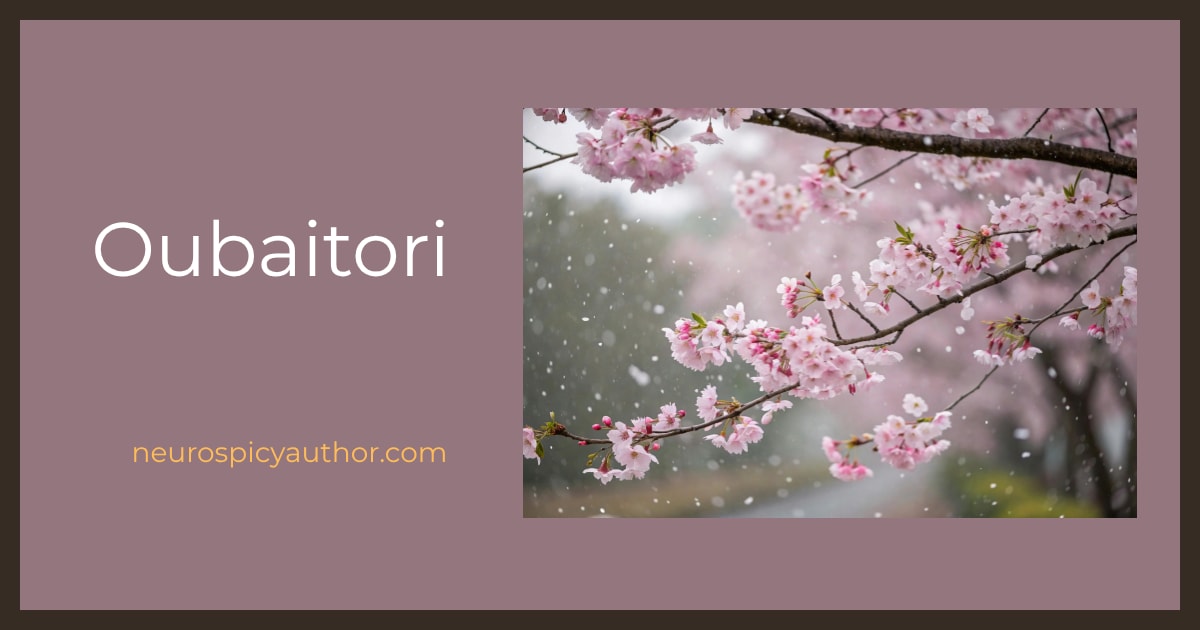
The Japanese concept of not comparing yourself to others, drawn from the observation that cherry, plum, peach, and apricot blossoms each open in their own time, in their own way, without reference to each other.
There is a particular kind of ache that doesn't have an obvious name.
It isn't jealousy, not exactly. It's quieter than that. It arrives when you watch someone else reach something you haven't reached yet, finish something you haven't finished, bloom in a season you're still waiting for. You don't wish them harm. You don't even wish they hadn't made it. You just become suddenly, painfully aware of the distance between where they are and where you are.
And then, almost immediately, the measuring begins.
Japanese has a word for the practice of stopping that measurement before it starts. It comes from an observation so simple it's almost embarrassing: the cherry blossom does not compare itself to the plum blossom. The peach does not wait to see when the apricot opens before deciding it is time. Each one blooms in its own season, at its own pace, according to its own nature. None of them is late. None of them is early. None of them is wrong.
The word is oubaitori.
What the neighboring trees cost you
There is nothing neutral about comparison. Every moment you spend measuring your timeline against someone else's is a moment your attention has left your own soil.
And soil that isn't attended to doesn't bloom on schedule. It doesn't bloom at all.
This is the quiet damage that comparison does. Not the ache of feeling behind, though that's real enough. It's what the ache pulls your attention away from: the particular conditions of your own ground, the specific work only you can do in it, the season that is actually yours right now whether or not it matches anyone else's calendar.
The neighboring trees are not your reference point. They never were.
What forcing a season costs you
For a neurodivergent nervous system, this is not a metaphor. It is a lived experience.
Most neurodivergent people have spent years, sometimes decades, being told they are behind. Developing late. Reaching milestones on the wrong schedule. Blooming in the wrong season. The message, delivered in a hundred different ways, is that your natural timeline is incorrect and needs to be corrected.
What that message costs is not just confidence. It costs you the energy you could have spent cultivating your own soil, redirected instead into the exhausting work of pretending to be a different kind of tree.
A cherry blossom forced to bloom in winter doesn't become stronger. It becomes damaged. The season it was trying to skip was never optional. It was preparation.
Your timeline is not a flaw. It is information about what kind of tree you are and what conditions you actually need.
Cultivating your own soil
Oubaitori is not a consolation prize for people who didn't bloom on time. It is a reorientation of attention toward the only ground you can actually tend.
What does your soil need right now? Not what should it need, not what does everyone else's soil seem to need, but what does yours actually require in this season? More rest than seems reasonable? A longer preparation than the schedule allows? A different kind of light than the standard conditions provide?
These are not deficiencies. They are the specific requirements of your particular nature, and attending to them is the only way you actually bloom.
The cherry blossom doesn't apologize for not being a plum blossom. It doesn't arrive late. It arrives exactly when a cherry blossom arrives, which is the only time it was ever going to.
So do you.
Tend your own soil. Your season is already underway.
-- Ptim
Ptim Pellerin is a neurodivergent author, composer, and optical scientist based in Houston. His work explores the intersection of science, art, and neurodivergent experience.