*On gold, cracks, and the neurodivergent art of becoming whole.*
---
There is a Japanese art form called kintsugi.
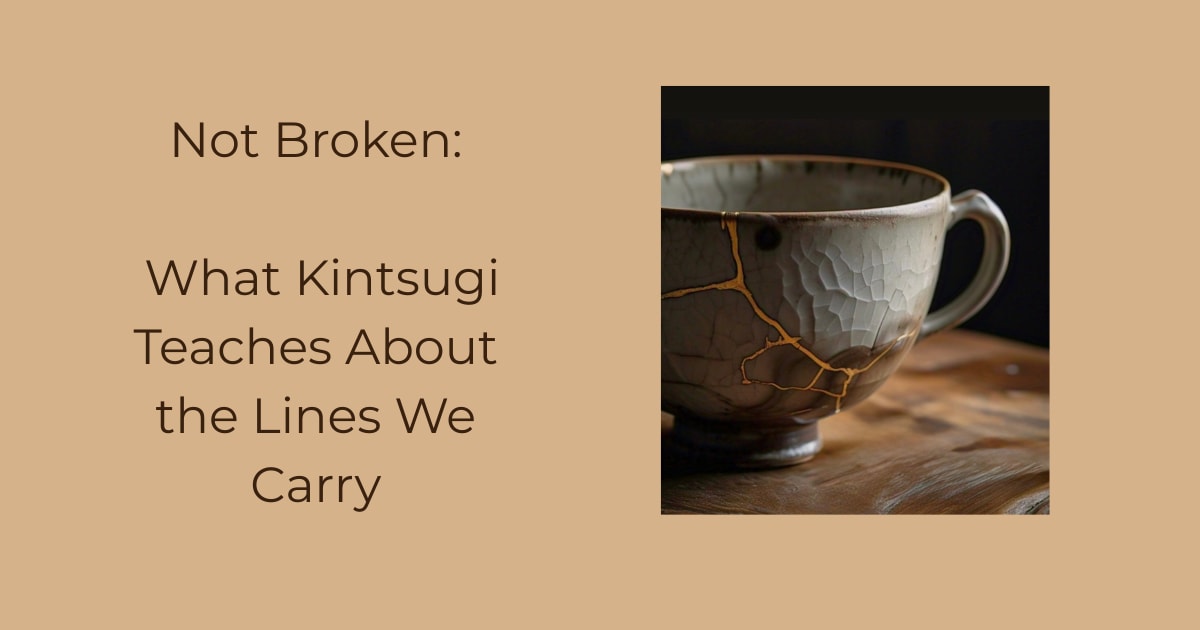
When a ceramic bowl breaks, the artist doesn't discard the pieces. Doesn't sand the damage smooth and pretend it never happened. Instead, they repair the object with lacquer mixed with gold — tracing every crack with light, filling every fracture with something precious, until the broken places become the most visible and beautiful part of the whole.
The philosophy behind it is simple. And once you sit with it, it changes something.
For those of us with neurodivergent minds, kintsugi is not just a metaphor. It is a mirror.
Most of us spent a significant portion of our lives learning to hide the places where we broke — or where the world broke against us. We learned to mask. To perform neurotypicality like a second language we were never quite fluent in. To apologize for our attention, our sensitivity, our intensity, the particular way our nervous systems moved through space. We learned, through repetition and consequence, that the cracks were problems to be managed. Evidence that something had gone fundamentally wrong in the making of us.
Nobody told us we could fill them with gold.
Nobody told us the cracks were the story.
Here is what I've come to understand, slowly and imperfectly, over decades of living in a mind that the world wasn't built for: the breaking is not where things went wrong. The breaking is where things got interesting.
The sensitivity that made certain environments unbearable also made me capable of perceiving things at frequencies most people never access. The hyperfocus that made me difficult to reach also made me capable of going deeper into a subject than most people ever go. The pattern recognition that made social rules feel arbitrary also let me see connections across scales — from the microscopic to the cosmic — that I'm still not finished mapping.
These are not consolation prizes. They are the gold in the cracks.
But you can only see them if you stop trying to hide where you broke.
The kintsugi artist does something that takes real courage: they make the repair visible. They don't return the object to what it was before. They acknowledge that the object has a history — and they honor that history by making it impossible to ignore. This is, I think, what neurodivergent people are being asked to do when we talk about unmasking. Not to perform brokenness. Not to use our neurodivergence as an excuse or an identity costume. But to stop pretending the cracks aren't there — and to start wondering what they might look like filled with something true.
There is a version of you that exists before the masking begins. Before the apologies. Before the years of contorting yourself into shapes that were never yours. That version is still in there. And the work — the slow, sometimes painful, non-linear work — is finding your way back to it. Not to fix it. To trace it with gold.
I think about what it means that a culture developed an entire art form around this idea. That someone, centuries ago, looked at a broken bowl and thought: what if the damage is the point? What if we stopped treating fracture as failure and started treating it as information — as the record of a life fully lived, of something that has been used and dropped and put back together and used again?
That bowl holds things differently now. It has a history you can see. And it is, by any honest measure, more interesting than it was before it broke.
So are you.
The lines you carry — from the diagnoses that came too late or too bluntly, from the classrooms and offices that were not designed for a mind like yours, from the years of not fitting and not knowing why — these are not evidence of failure. They are evidence of survival. Of a life fully inhabited inside a world that made it harder than it needed to be.
The question kintsugi asks is not how do we erase the damage. The question is what becomes possible when we stop trying.
I don't have a clean answer to that. The practice of it — of actually treating your own broken places as something worth honoring rather than hiding — is ongoing and uneven and sometimes it circles back on itself. But I keep returning to that image. The bowl. The gold running through the cracks like rivers on a map. The artist who looked at something broken and decided to make the repair beautiful.
That's the work. And it's worth doing.
*— Ptim*
*Ptim Pellerin is a Houston-based neurodivergent author and musician.*
March 13, 2026
Not Broken: What Kintsugi Teaches Us About The Lines We Carry