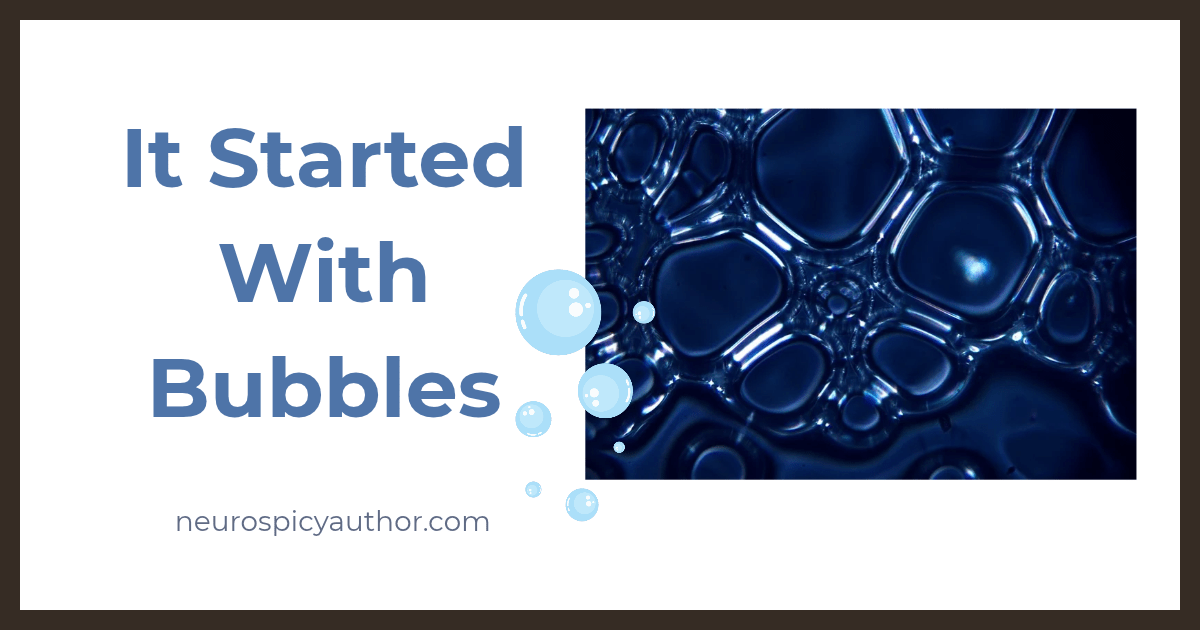
I was looking at bubbles under the microscope.
Not for any particular reason. There was a slide, there was a microscope, and there were bubbles trapped in the medium, and something about the way they held their shape at that magnification made me stop and look longer than I meant to. The geometry of a bubble at that scale is surprisingly precise. The surface tension that keeps it intact is doing serious work, and you can see that work in the perfect curve of the wall.
That was the beginning.
What bubbles do under pressure
A bubble exists because the pressure inside it is in equilibrium with the pressure outside it. Surface tension holds the boundary. The gas inside pushes out, the liquid outside pushes in, and the bubble persists at the exact point where those forces balance.
When the external pressure increases suddenly and dramatically, that balance fails. The liquid collapses inward faster than the gas can escape. The bubble doesn't pop the way a soap bubble pops, gently and outward. It implodes. The walls rush toward the center and collide with enough force to generate a shockwave, a flash of heat, and a pressure spike that lasts microseconds but reaches intensities that can pit metal and break molecular bonds.
This is cavitation. It happens in ship propellers, in damaged heart valves, in water moving too fast through a pipe. It is one of the most destructive forces in fluid dynamics, and it begins with something as ordinary as a bubble.
I did not go looking for cavitation. Cavitation found me because I was looking at bubbles and couldn't stop asking what they do next.
The cleaning tank
Once you know what cavitation is, you start seeing it everywhere it was already being used.
An ultrasonic cleaner is a tank of liquid with a transducer at the bottom that vibrates at frequencies between twenty and forty thousand cycles per second. That vibration creates pressure waves in the liquid. The pressure waves create bubbles. The bubbles implode. The implosions happen at every surface submerged in the tank, including the surface of whatever you're trying to clean, and the shockwaves knock contaminants loose at the microscopic level.
It is an extraordinarily precise cleaning mechanism. I use one regularly in the optical lab. I have used one for years. I understood, in a general way, how it worked.
What I had not done, until I was looking at bubbles on a slide and followed the thread all the way here, was think about what else those pressure waves and vibrations might be doing to things submerged in the tank.
The experiment I haven't run yet
Vibration affects crystal growth.
This is not a new discovery. Acoustic fields influence nucleation, the process by which crystals begin to form from a solution. The pressure waves can affect where crystals start, how large they grow, and what shape they take. Researchers have used ultrasonic fields to control crystal morphology in pharmaceutical manufacturing, in materials science, in food processing.
I want to put a supersaturated solution on a slide, set it on the plate of my ultrasonic cleaner, and watch what happens.
I want to see whether the crystals that form under vibration look different from the ones that form in stillness. I want to photograph them under the microscope and compare them. I want to know what a shockwave does to the geometry of a crystal at the moment of its formation.
I haven't done this yet. The experiment is pending. The chain of thought got here before the experiment did, which is exactly how this kind of thinking works.
What this has to do with your brain
The neurodivergent mind does not stay where you point it.
You point it at bubbles. It goes to surface tension, then to pressure, then to implosion, then to cavitation, then to ultrasonic cleaners, then to crystal growth, then to an experiment you are now genuinely invested in running even though you came in to photograph something else entirely.
This is not distraction. It is the opposite of distraction. It is a quality of attention that follows a thing to where the thing actually goes, that cannot look at a bubble without asking what a bubble does, that cannot learn what a bubble does without asking where else that happens, that cannot discover where else that happens without immediately wanting to see what it does to something new.
The world is full of people who looked at a bubble and moved on. Some of them are very productive. Some of them have clean desks.
But the people who couldn't stop looking, who followed the thread from the bubble to the implosion to the cleaning tank to the crystal growing in a field of shockwaves at forty thousand cycles per second: those people are also doing something. Something that looks like wandering and is actually a very specific kind of work.
I still need to grow the crystals. The experiment is still pending.
But I know something now that I didn't know when I sat down at the microscope, and I know it because I couldn't stop looking at a bubble.
That's usually how it goes.
-- Ptim
Ptim Pellerin is a neurodivergent author, composer, and optical scientist based in Houston. His work explores the intersection of science, art, and neurodivergent experience.