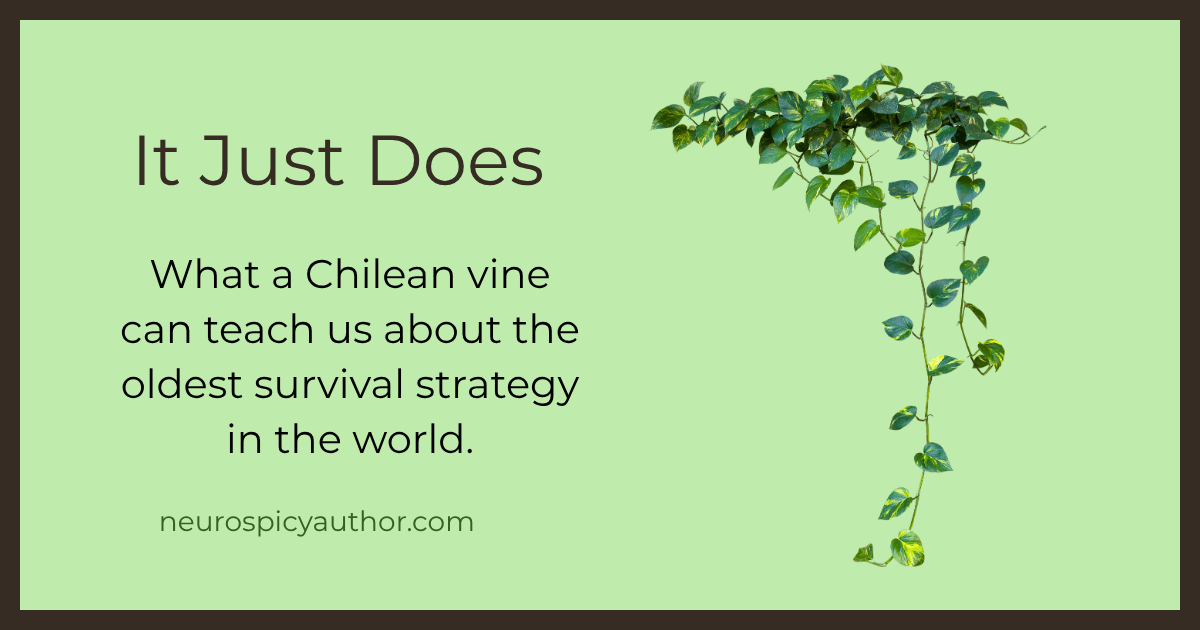
There is a vine in the forests of Chile that should not be able to do what it does.
Boquila trifoliolata climbs whatever host plant it finds and reshapes its own leaves to match. Not approximately. Precisely. The size, the shape, the color, the texture, the pattern of veins running through the leaf surface. It reads the host and becomes it, so completely that botanists have spent years trying to understand the mechanism and have not found a satisfying answer.
The vine has no eyes. No nervous system. No apparent way of perceiving what it is supposed to become.
And yet it becomes it.
What the science says
Several hypotheses exist. Airborne chemical signals from the host plant. Microbes in the soil carrying information between root systems. Even, in one paper that caused considerable debate, the possibility of some form of plant vision, light receptors sensitive enough to detect and process the shape of neighboring leaves.
None of these explanations is fully settled. The mechanism remains genuinely unresolved.
What is not unresolved is the outcome. The vine masks. It does so reliably, precisely, and without any process we can currently identify. The how is a mystery. The what is simply what the vine does.
The pattern that keeps repeating
This is where it gets interesting.
Masking is not a uniquely human behavior. It is not even a uniquely animal behavior. Evolution arrived at the same strategy independently, in a plant with no brain, no social awareness, no capacity for self-reflection. Which suggests something important: the impulse to become indistinguishable from your environment is not a quirk or a flaw or a choice. It is one of the oldest survival strategies life has found.
When conditions are dangerous, become the background. When visibility means vulnerability, become the leaf of whatever you are climbing. When the cost of being seen as different is too high, reshape yourself until the difference disappears.
The vine doesn't decide to do this. It just does.
What neurodivergent people know about this
Masking, in the human context, is the practice of suppressing or camouflaging neurodivergent traits to appear neurotypical. Monitoring your own facial expressions. Scripting conversations in advance. Forcing eye contact that doesn't come naturally. Mimicking the social rhythms of the people around you so precisely that nobody notices the effort it takes.
Like the vine, most people who mask didn't decide to start. It developed gradually, in response to an environment that made the cost of visibility clear. A look, a correction, a moment of social exclusion that registered below the level of conscious decision and above the level of something you could easily name. The nervous system filed the information and adjusted accordingly.
By the time most neurodivergent people become aware they are masking, they have been doing it for years. The behavior is automatic. The adaptation is complete. And like the vine, the mechanism is not always visible even to the person doing it.
The cost the vine doesn't pay
Here is where the metaphor breaks.
The vine expends energy reshaping its leaves, but it doesn't lose itself in the process. It is still boquila trifoliolata. The host plant's shape passes through it without replacing what it is.
For a human nervous system, sustained masking carries a different cost. The energy it requires is real and cumulative. The suppression of natural responses, maintained across years and decades, produces a particular kind of exhaustion that is difficult to explain to someone who has never had to do it. And over time, the line between the mask and the face beneath it can become genuinely hard to locate.
The vine always knows what it is. The person who has been masking since childhood sometimes doesn't.
What the vine gets right
The vine masks because its environment requires it. When the environment changes, when it climbs a different host, it changes too. The mask follows the context. It is always a response to something external, never a replacement for something internal.
This is the most useful thing the vine has to teach. Masking is a response to an environment, not a definition of a self. The leaf shape changes. The vine remains.
You were always still there, underneath the shape you learned to make.
The vine doesn't decide to mask. It just does. So did you. And that was never the whole story.
-- Ptim
Ptim Pellerin is a neurodivergent author, composer, and optical scientist based in Houston. His work explores the intersection of science, art, and neurodivergent experience.