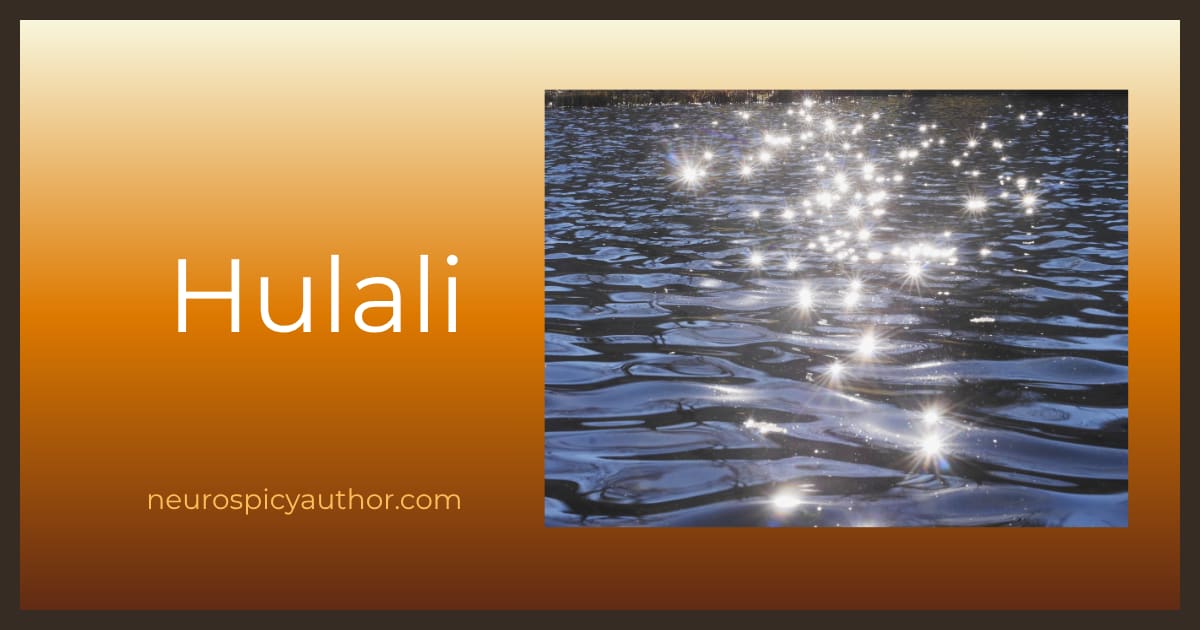
The Hawaiian word for the shimmer of light on moving water. There is no English equivalent.
I stopped walking without deciding to.
It was the water that did it. Not the water itself but what the light was doing to it, the way the surface had come alive with a thousand small fires, each one appearing and vanishing before I could hold it. I stood there longer than made sense. I couldn't have told you why. Something was happening in that shimmer that required my full attention, even though nothing was happening at all.
If you have ever been stopped by light on water, you already know the word.
What it means
Hulali is a Hawaiian word meaning to shimmer, glisten, or sparkle. It is used most often to describe what sunlight or moonlight does when it moves across the surface of the ocean: that living, breathing quality of light on water that seems to carry meaning it can't quite deliver.
The word is not about the light. It is not about the water. It is about what happens between them, that brief, unrepeatable dance that exists only in the meeting of two things in motion.
English has no single word for this. We say glitter, sparkle, shimmer, dazzle, each of them gesturing toward the phenomenon without quite landing on it. Hulali lands on it.
The person who notices
Most people see the shimmer. A neurodivergent nervous system tends to be stopped by it.
This is not a disorder. It is a particular quality of attention, the capacity to be genuinely arrested by sensory phenomena that others register and move past. The shimmer on water is not background information to this kind of mind. It is foreground. It is signal. Something in it is worth attending to, even if you could not explain what, even if you stood there past the point of social reasonableness, watching a surface do what surfaces do when light finds them.
A voyeur of shadows is also a voyeur of light.
The same perceptual wiring that tracks the angle of a shadow across a wall, that notices the particular blue of dusk before anyone else in the room has looked up, is the wiring that finds hulali irresistible. It isn't distraction. It is a different threshold for what counts as worth seeing.
What the shimmer is actually doing
Light on moving water is not a single thing. It is thousands of small events, each one a reflection from a different angle of a surface that won't hold still. What you see as shimmer is actually the accumulated flicker of countless individual moments of light, none of them identical, none of them lasting.
You cannot watch hulali and see the same thing twice. The surface is always already different. What caught your eye a moment ago has already become something else.
This is partly why it holds attention so completely. The pattern keeps almost resolving. The eye keeps trying to catch the next one. The shimmer is a moving target that never stops moving, which means the watching never quite finishes.
If you know this arrest
You have probably stood somewhere longer than you meant to because of what light was doing.
On water, yes. But also on glass. On the underside of a leaf. On the wall of a room where something reflective was catching the afternoon. On a puddle in a parking lot that had no business being as beautiful as it was.
This is hulali. Not just the shimmer itself but the experience of being held by it, of recognizing that something is happening in the light that your nervous system has decided is worth the full cost of your attention.
It was always worth it.
Give it the Hawaiian name it deserves.
-- Ptim
Ptim Pellerin is a neurodivergent author, composer, and optical scientist based in Houston. His work explores the intersection of science, art, and neurodivergent experience.