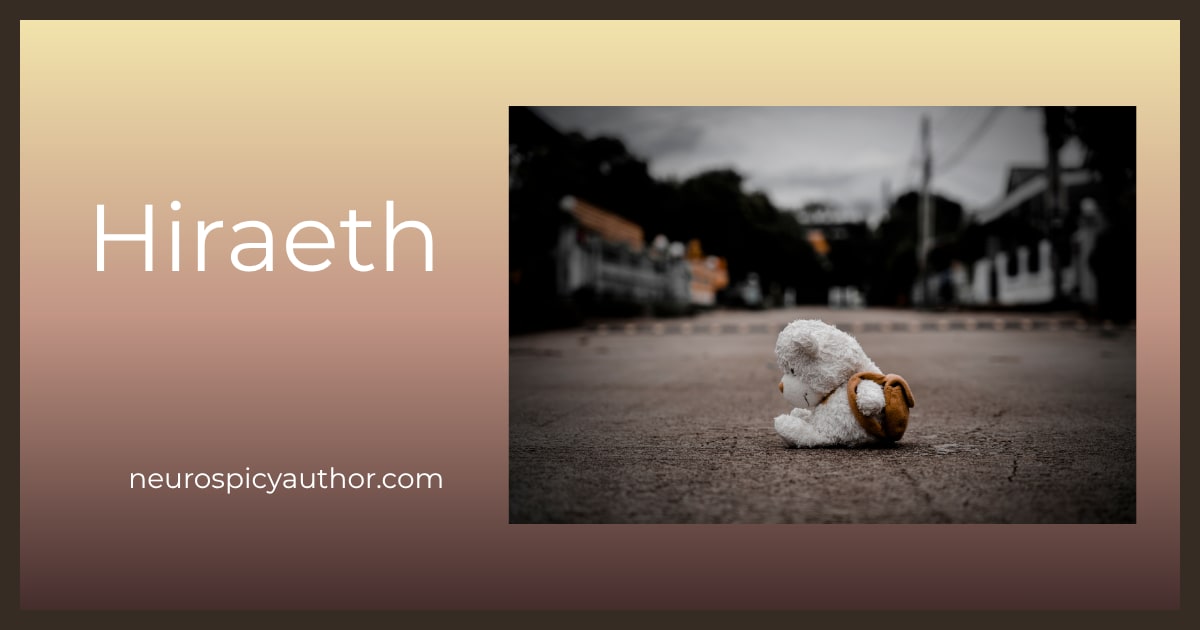
The Welsh word for a homesickness for a home you cannot return to, or that may never have existed. There is no English equivalent.
Something has changed and you cannot say exactly when.
Not a single event, not one decision or moment you can point to. Just the slow accumulation of small shifts until one day you looked up and the place you were standing no longer felt like the place you remembered. The geography is the same. The streets are in the same position. The people you love are still there.
But something is gone that you cannot name, and you don't know how to go back to it, and you are not entirely sure it was ever exactly the way you remember it.
The Welsh call this hiraeth.
What it is
Hiraeth is not nostalgia. Nostalgia is warm. It reaches back toward something sweet and a little soft, a memory that has had its edges worn smooth by time. You can visit nostalgia like a photograph. It doesn't ask anything of you.
Hiraeth asks something of you. It sits in the chest differently, heavier and less resolved. It is the grief of a distance you cannot measure because you don't know exactly what you have lost or whether you ever fully had it. It is homesickness for a home that may exist only in the feeling itself.
This is why it has no English equivalent. English has words for missing things you can name. Hiraeth is for the thing you can't quite name, the version of the world that lived in your sense of what was possible, in your understanding of where you were, in the feeling that the ground beneath you was recognizable.
What the world is doing to people right now
Across every divide, across every position and perspective, something is being felt that hiraeth names better than anything English offers.
The sense that the country you thought you lived in has changed past the point of recognition. That the communities you belonged to have fractured in ways that can't be fully repaired. That the shared understanding you thought existed, about what was decent, what was possible, what was true, has dissolved into something unrecognizable.
This feeling does not belong to one side of any argument. It belongs to everyone who is grieving a version of the world they thought they knew. The specifics are different. The hiraeth is the same.
You are not homesick for a place. You are homesick for a world that felt navigable. For a time when the ground felt more solid than it does now. For a version of things that may have been partly imagined but was real enough to live inside.
The particular weight of not knowing
What makes hiraeth different from ordinary grief is that ordinary grief has an object. You know what you lost. You can name it, visit its absence, move through the stages of coming to terms with it.
Hiraeth doesn't give you that clarity. The loss is real but the object is diffuse. You are grieving something that was never fully formed, a sense of things, a feeling of home that was always partly a construction and is now no longer even that.
This is why it is so hard to talk about. When you try to explain it, it sounds like nostalgia for something that wasn't as good as you remember. People will tell you the world was never as safe or as fair or as stable as you thought it was. They are probably right. And the hiraeth remains anyway, because it was never about the facts of the place. It was about the feeling of being at home in it.
You can know that something was imperfect and still grieve its loss. The two things do not cancel each other out.
What to do with it
Hiraeth doesn't resolve. That is part of its nature. You cannot go back to a place that existed primarily as a feeling, and you cannot manufacture the feeling by returning to the place.
What you can do is name it. Give it the weight it deserves without either dismissing it as mere nostalgia or being consumed by it as though the loss were total. The world has changed. You are grieving that change. That grief is legitimate even if the thing you are grieving was never perfect, even if it was partly imagined, even if others are grieving a completely different version of the same loss.
Hiraeth is the word for standing in a place that is still technically home and feeling the distance from it anyway.
You are not alone in that feeling. Right now, more people than you know are standing in the same distance.
Give the ache its name.
-- Ptim
Ptim Pellerin is a neurodivergent author, composer, and optical scientist based in Houston. His work explores the intersection of science, art, and neurodivergent experience.