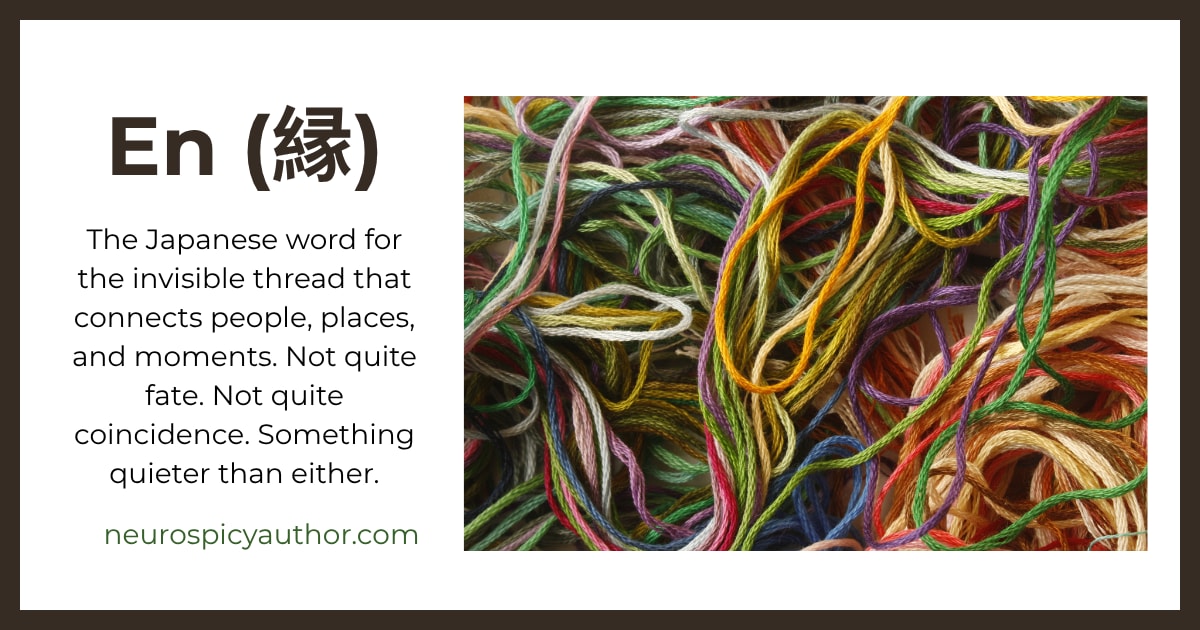
The Japanese word for the invisible thread that connects people, places, and moments. Not quite fate. Not quite coincidence. Something quieter than either.
You didn't end up here by design.
Not exactly. There was intention, yes. Effort, certainly. Choices made at crossroads you remember clearly. But the life you are actually living, the specific shape of it, the people in it, the work that feels like yours, the city or the room or the corner of the world where you finally exhaled, that was not the result of a plan. It was the result of a sequence.
One thing led to another. And another. And here you are.
Now think about the person who changed everything. Not why they mattered. How they got there. The job you almost didn't take that put you in the same room. The event you nearly skipped. The city you ended up in for reasons that had nothing to do with them. Pull that thread far enough and the whole thing dissolves into improbability. The life you are living was assembled, in part, by a series of encounters that nobody planned.
The Japanese have a word for what was happening in all of those moments.
What en means
En (縁) is sometimes translated as fate, connection, or destiny. But none of those words quite capture it. Fate implies something predetermined and fixed. Destiny carries the weight of inevitability. En is softer than both.
It sits between destiny and coincidence, softer than either, describing something that feels guided without being predetermined. It describes the invisible thread that exists between people, the gentle force that draws certain encounters into being, the quality of a meeting that feels like more than coincidence without quite being something you can name.
En can exist between people, but also between a person and a place, a person and a piece of work, a person and a moment in time that changes the direction of everything that follows. It is the word for the feeling you get when you look back and see that something was working that you didn't know about at the time.
The thread you didn't know you were holding
Most significant connections arrive sideways.
Not through the channels you built for them. Not as the result of deliberate searching. They come through a mutual friend who almost didn't make the introduction. A conversation that happened because you were in the wrong place at the right time. A city you moved to for one reason that turned out to be the gateway to something entirely different.
En suggests that this is not random. That the thread was always there, connecting you to the person or place or moment before you knew it existed. The encounter feels predestined only in retrospect, but the retrospective recognition is real: something was pulling toward something, and you were both moving through conditions that would eventually bring you to the same point.
You didn't plan it. But it wasn't nothing.
Why this concept doesn't translate easily
Western thinking tends to emphasize individual choice. You decided. You acted. You built the life you have through the force of your own will and intention. This is not entirely wrong, but it is not the whole story either, and most people know it. The choices that mattered most were often made with incomplete information, in conditions you didn't create, toward outcomes you couldn't have predicted.
En has roots in Buddhist philosophy, where the original meaning centered on the cause-and-effect relationships that underlie all things. The personal, relational meaning came later, but the philosophical foundation is still there: everything arises from conditions, and some conditions draw people together in ways that feel like more than accident.
En holds space for the part of the story that individual will doesn't explain. The part where something larger than your intentions was also at work.
What a neurodivergent mind does with en
The brain that tracks patterns, that holds a long memory, that notices the relationship between seemingly unrelated things: this is the brain that tends to feel en most acutely.
You can see the threads. You can trace the chain from a small encounter years ago to where it eventually led. You can map the sequence of people and places and moments that assembled the life you have now, and see clearly that you could not have planned it, that the planning you did only got you partway there, and that something else accounted for the rest.
This can feel like a gift. It can also feel like standing at the edge of something, seeing the architecture of your own life clearly enough to understand how contingent it was. How easily it could have been otherwise.
En doesn't resolve that. It just gives it a name, and names, as this series keeps finding, have a way of making the weight easier to carry.
The encounters worth honoring
Gratitude for the life you have is complicated when you can see how improbable it was.
It wasn't earned in a straight line. It wasn't the inevitable result of good choices and hard work, though those mattered. It emerged from a series of encounters and accidents and small decisions that compounded into something you couldn't have built deliberately if you'd tried.
There is a Japanese phrase, ichi-go ichi-e (一期一会): this moment, this meeting, will never come again. Treat it accordingly.
En and ichi-go ichi-e belong together. If certain connections carry invisible threads that draw them into being, then every encounter that feels weighted with significance deserves to be received with care. Not every meeting is en. But the ones that are, you usually know. Something settles differently. Something in you recognizes something.
Pay attention to those.
If you trace the thread
Find the person who introduced you to the person. Find the city you ended up in for reasons that turned out to be the wrong reasons for the right destination. Find the job you took reluctantly that opened the door you needed. Find the conversation that happened because you said yes when you usually would have said no.
These were en. The invisible threads doing their work, drawing the conditions together, placing you where you needed to be to meet what was coming.
You didn't plan this life. But you weren't entirely on your own in building it either. Something else was at work in the sequence, something that doesn't have a satisfying name in English but that most people recognize when they look back at their own lives honestly.
Now it does have a name.
Honor the thread. And the one who was holding the other end.
-- Ptim
Ptim Pellerin is a neurodivergent author, composer, and optical scientist based in Houston. His work explores the intersection of science, art, and neurodivergent experience.